Local guide
Kompong Phluk: Stilt Houses, the Flooded Forest and What It Costs
The stilt village 45 minutes from Siem Reap. What the boats cost, which season to go, why we don't eat there, and the sunset out on the lake.
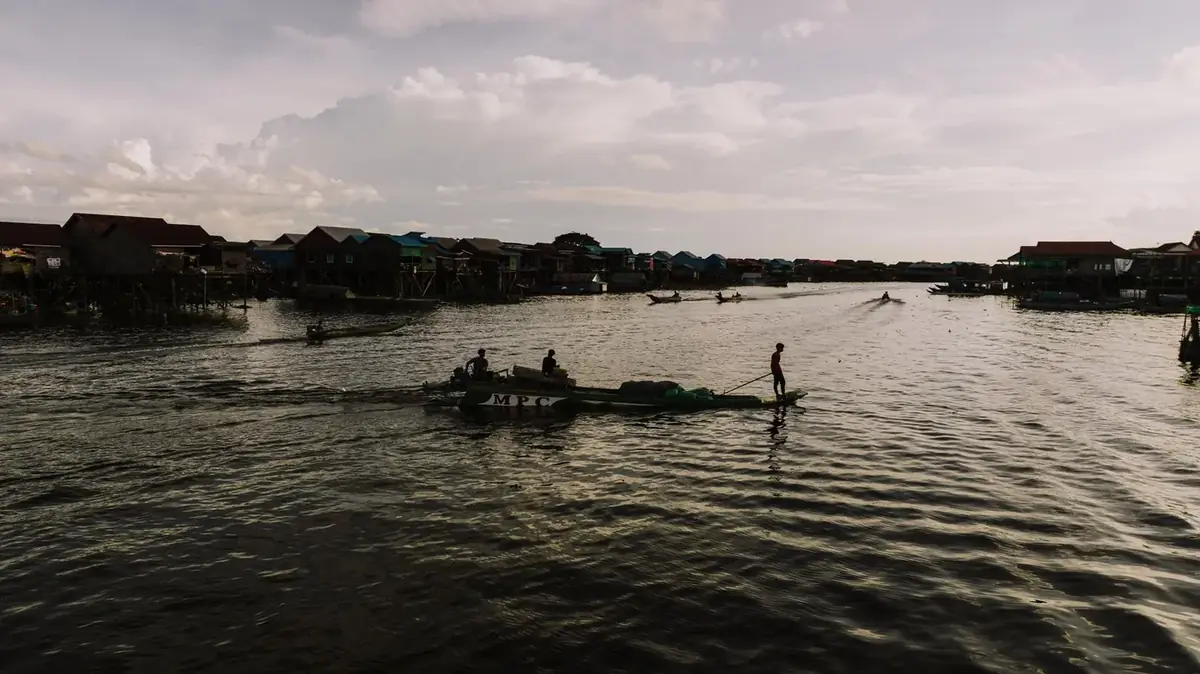
Kompong Phluk (also spelled Kampong Phluk) is a village of stilt houses on the edge of the Tonle Sap, about 45 minutes from Siem Reap. It is one of the best half days you can spend outside the temples, and it sits in our guide to the best things to do in Siem Reap for that reason. If you are still choosing between the floating villages, start with our floating village guide, which compares all four.
Quick facts, October 2026:
- About 30km from town, 45 minutes by road, then about 30 minutes by boat.
- The houses stand on wooden stilts 6 to 9m tall.
- 911 families, about 3,700 people (2019 count).
- The village boat is $23 a person, set by the community. Our guests pay $20.
- The paddle boat through the flooded forest is $11 per boat, one or two people, wet season only.
Even locals stop and stare
Sitha, our guide, first went out to Kompong Phluk in 2015. He wasn't guiding then, he was driving guests there. What stayed with him was how surprised he was, as a Cambodian.
On land, our houses sit on thick concrete pillars. Out here the stilts are long, thin wooden poles, 6 to 9m high, and they hold up through years of the lake rising and falling under them. He still wonders how they last.
The other thing is harder to see in photos. The houses are close together, but in the wet season you can't walk next door. To visit a neighbour or buy food, you row. Cambodians are very social people, and Sitha says he couldn't live with that: everyone close by, and everyone a boat ride away.
The drive out
The road to Kompong Phluk runs past rice fields, and guests ask us to stop all the time, usually for buffaloes and cows. For us they are ordinary. For a lot of guests they are the first water buffalo they have seen up close, so we stop. We also stop at a local market on the way.
Those stops are where the idea for our tours came from. We started looking at Siem Reap through our guests' eyes, and we found the everyday things were often what they remembered.
Wet season or dry season
The water peaks around October. At its highest it comes up to about a metre below the floors of the houses, a rise of 4 to 5m since the dry season.
In the wet season the water is clearer and greener, and the women of the village row you through the flooded forest in small paddle boats, under the branches. It is the prettiest version of Kompong Phluk, and most guests love it.
In the dry season, roughly March to May, the water is low and brown next to the mud, and the paddle boats stop because there is no water in the forest. Some guests prefer it anyway. With the water down, daily life is out in the open: you can watch how people live, almost like looking through a window. Both seasons are worth it, they are just different trips.
What the boats cost, and where the money goes
The community runs the boats. Every family has one, and families take turns, both rowing the small paddle boats and running the bigger boat between the landing and the village. Part of every fare goes into a fund for the whole community, and the rest goes to the family running the boat.
The community price for the village boat is $23 a person. On our tours you pay your guide $20 a person on the day, and we pay the community the full $23. It makes change easier, and we can afford it because every booking comes to us directly, with no booking platform taking a cut.
The paddle boat through the flooded forest is $11 per boat. It takes one or two people, and it is still $11 if you go alone.
Guests tell us that on other trips the boat cost more than the community price. That happens when a tour has to make back what a booking platform takes, so it adds to the boat price or stops at shops that pay it commission. We don't take you to places that pay us, we don't push souvenirs, and you won't pay more than the community asks.
Is it ethical to visit?
People in Kompong Phluk know that visitors are a big part of how they can afford to live there, and the boat fund is how the whole village shares in it. They are used to photos and videos, and they are happy if you stop to talk. They go about their day as usual, and nobody puts on a show.
The one thing that makes people uncomfortable is children, and sometimes older people, selling books or pens for $1 or $2. It is not a scam, it comes from wider money problems, and it happens at most tourist spots in Cambodia. The official Angkor visitor code of conduct asks visitors not to buy from children, because it pulls them out of school. We agree. Part of every booking goes on books and pencils, which we give to primary-school teachers, so the help reaches the classroom.
Food: eat in town
People in Kompong Phluk eat a lot of fish, from the lake. We don't recommend eating in the village, and we don't arrange any food there. Living on the water, away from land, means no proper bathrooms and no proper restaurants, and hygiene is not what you get in town. Eat in Siem Reap before or after.
Sunset on the lake
In any season, the boat can carry on past the village out onto the open Tonle Sap. The sunset out there is one of the prettiest in Siem Reap, and it is the part I recommend most.
That is why we run Kompong Phluk two ways. The morning trip leaves at 8:00am, stops along the way by boat at a local pagoda and other places, and has you back at your hotel by about 1pm, with the option to carry on to other villages. The sunset trip leaves at 3:00pm, so you are not waiting out the middle of the day, and finishes on the lake.
Book the visit
Our Floating Village Tour goes to Kompong Phluk or Kampong Khleang, morning or sunset, with a Ministry-certified local guide. One price for your whole group, and you pay your guide $20 a person for the boat on the day.