Siem Reap Floating Village: How to Visit Responsibly
Which floating village to visit, which to skip, what the boats cost, and how the season changes the trip. Written by a local guide.

Most of what gets sold as a "Siem Reap floating village tour" goes to Chong Khneas, and Chong Khneas is the one I usually steer my guests away from. Because it's the closest village to town, it gets busy. The boats are overpriced and the loop feels short and rushed. That is the version most people book, and it's part of why the whole idea has picked up a mixed reputation.
The better trip is still out there on the Tonle Sap. You just drive a bit past the easy option to reach it.
Quick facts, July 2026:
- Short answer: yes, go, but drive past Chong Khneas to Kampong Phluk or Kampong Khleang.
- We go to Kampong Khleang (about 55km, 60 to 75 minutes by road) or Kampong Phluk (about 30km, 45 minutes), your choice.
- The best months are roughly August to December, when the water is high.
- On our tours the village boat is $20 a person, paid to your guide on the day, at both villages.
- At Kampong Phluk, the small paddle boats through the flooded forest are $11 per boat (one or two people). Local women row them, and they're the best part.
- Skip Chong Khneas, the closest and busiest one.
- The trip takes about 4 to 5 hours. Most people go in the morning for the weather. After 3pm you get the sunset too.
Why the floating village has a bad reputation
The trouble is the circuit built around the closest village.
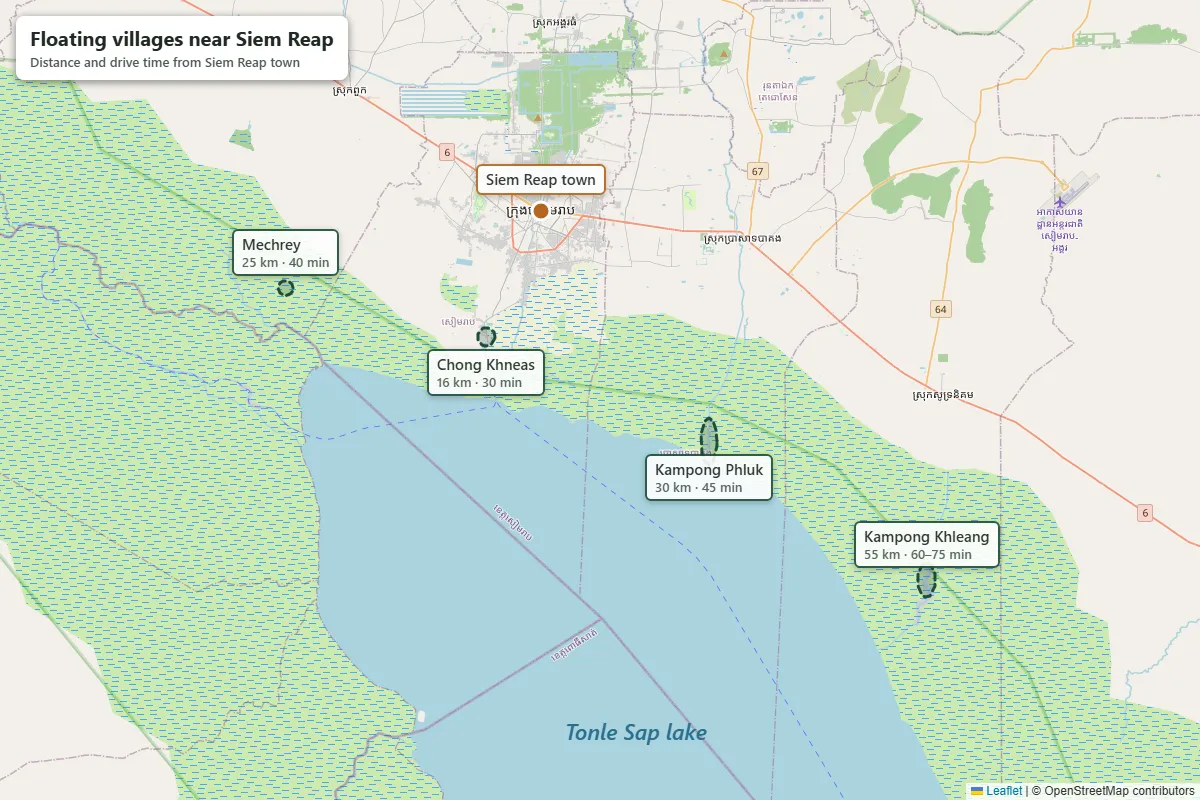
Chong Khneas sits about 16km from town, so it's the default for anyone who booked a cheap half-day online. Because it's easy to reach, it gets busy, and the boat prices reflect that. The loop is short, and you can feel like you're being moved along quickly. Some visitors also get nudged toward floating shops or donation stops where prices are marked well above what things are worth.
None of that is the fault of the families who live on the lake. It's just what happens when a village becomes the closest, easiest stop for day trippers. Drive a bit further out and that pressure eases off, because those communities were never built around tour groups in the first place.
Which Tonle Sap floating village should you visit
Each of the four names you'll see is a different trip.
| Village | Distance from town | Drive | Crowds | My verdict |
|---|---|---|---|---|
| Chong Khneas | ~16km | ~30 min | Busy, closest to town | Skip it |
| Mechrey | ~25km | ~40 min | Light, small village | Fine, but less to see |
| Kampong Phluk | ~30km | ~45 min | Moderate | We go here, the one with the forest ride |
| Kampong Khleang | ~55km | 60 to 75 min | Light | We go here, the biggest and quietest |
Kampong Phluk is the reasonable compromise. It has the stilt houses and the flooded forest with the paddle boat ride, which Kampong Khleang doesn't have. It's also close enough for a relaxed half day and much calmer than Chong Khneas. If your schedule is tight, take it and don't feel like you missed out.
But if you have the morning, go the extra distance to Kampong Khleang. It's the largest floating village in the province, more than ten thousand people who fish and live their whole lives on and around the water, and it sees a fraction of the visitors precisely because it's the furthest out. The village would look exactly the same if you never showed up. Our floating village tour goes to either one, Kampong Khleang or Kampong Phluk, whichever suits you.
Wet season or dry season
The water level changes the whole trip.
In the wet season, roughly August into December, the Tonle Sap swells and the water comes up under the houses and into the trees. That is when the small boats at Kampong Phluk can take you slowly through the flooded forest, ducking under branches, the light coming through the leaves. That part is the best thing about the whole trip, and it only exists when the water is high.
At Kampong Phluk the water peaks around October, about a metre below the floors of the houses and 4 to 5m higher than in the dry season. You can't walk next door then. To visit a neighbour or buy rice, people get in a boat.
In the dry season it drains away. You can still go in January. The water is already much lower by then than in October and November. By March to May the level drops so far that roads which sit underwater half the year are dry enough to walk on. The stilt houses stand on their long legs over mud, the water that is left turns brown, and the forest ride stops because there's no water in the forest to float through. Some guests prefer that version, because with the water down, daily life is out in the open and easier to watch. You can go in either season.
What a responsible visit looks like
Most of a responsible visit comes down to where your money goes.
- Go to a village people live in, like Kampong Khleang or Kampong Phluk, and give the Chong Khneas loop a miss.
- At Kampong Phluk, take the small paddle boat and pay the woman rowing it directly, in cash. The $11 per boat goes to her and the village.
- If someone pushes a donation or a "buy rice for the school" stop with prices well above normal, you can say no. If you want to give, do it later through an established charity you can check.
- People are used to cameras and happy to talk, but ask before photographing children up close, and don't buy from kids selling books or pens. The official Angkor visitor code of conduct asks the same, because it keeps them out of school.
What it costs, and where the money goes
Cash on the ground, as of July 2026, works roughly like this.
| How you go | Cost | What it covers |
|---|---|---|
| Independent, tuk-tuk to Kampong Khleang | ~$30 to $35 round trip, plus $20 a person for the boat | Transport and boats, you negotiate everything yourself |
| Our visit, solo | $95 | Guide and transport, boat paid on the day |
| Our visit, private tuk-tuk (up to 3 adults) | $130 | Guide, private tuk-tuk and pickup, boat paid on the day |
| Our visit, private A/C SUV (2 adults and 1 child) | $150 | Same, with air conditioning for the drive |
| Our visit, private A/C minivan (up to 6 adults) | $165 | Same, for the bigger group |
The number to plan for is the boat. On our tours it's $20 a person at both villages, paid to your guide on the day. At Kompong Phluk the community price is $23, and we cover the difference. It's not included in our tour price. A family of four pays $80 for the boats on top of the trip. I'd rather tell you that up front than have you find out at the dock.
For our own trips, 5% of every booking is set aside for schools and clean water in village communities around Siem Reap. So far it has gone on books and pens, given to children and to a small school.
A quick story, because people live there
A while back I went to a wedding in Kampong Khleang. My cousin. And even as a Cambodian, someone who grew up in this province, I was a little surprised by how different things were out there. The way they cooked, the order the ceremony ran in, small customs I didn't quite expect. It's a place with its own life, its own way of doing a wedding, and you're lucky to pass through for a couple of hours.
Book the visit
If you want this done properly, with a Ministry-certified local guide (mine is Sitha Roet) who takes you out to Kampong Khleang or Kampong Phluk and knows how the day should run, this is exactly what our Floating Village Tour is built for.
A village visit takes half a day. If you're still filling the rest of the trip, here is what is worth your days in Siem Reap.