Local guide
Where Locals Eat in Siem Reap (and What to Order)
The breakfast dishes that sell out by 8am, the market locals shop at, why I would skip amok, and how to tell a clean food stall from a bad one. Written by a local guide.
Pub Street is not where I eat. I do not think I have had a meal there that I would tell a friend to go out of their way for. It is loud, it is priced for people on holiday, and the food is a softer version of what you get for less a couple of kilometers away.
I grew up in a village about 20km out of town, near Puok. So my idea of good food in Siem Reap starts at a market at six in the morning, not at a bar at nine at night. Here is where I go, what I order, and a few things worth knowing before you eat.
Quick facts, July 2026:
- The market to head for is Phsar Leu Thom Thmei, about 2km from the center, best in the morning.
- Breakfast is the meal that matters here. The good local dishes sell out by around 8am.
- A bowl of porridge or noodle soup runs $1 to $2.
- Pub Street runs about 1.5 times the price for the same food.
- Cambodians eat early because most of us come from farming families. The kitchen follows the field.
Start with breakfast, it is the meal that matters
If you only fix one thing about how you eat in Siem Reap, eat a proper local breakfast before 8am.
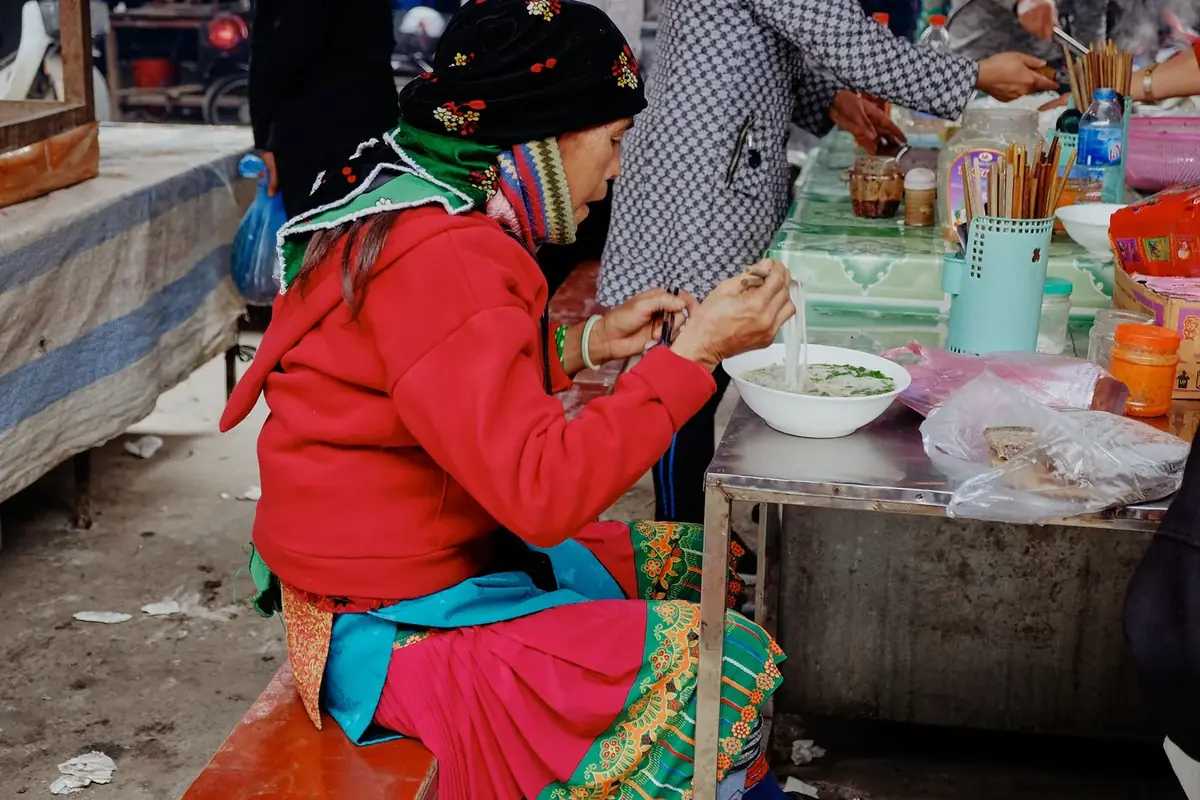
At Puok market, the thing I get is chicken or fish porridge. Congee, if that word means more to you. It is early food, and I mean early: the versions cooked by the people who know how to make it are gone by eight. Come at nine and you are eating leftovers or nothing.
The other breakfast staple is kuy teav. It is our rice-noodle soup, the closest thing we have to Vietnamese pho, served with thin rice noodles. One noodle type, more or less. We never built out the range of noodles you get in a place like China, and nobody here is bothered about that. Kuy teav is kuy teav. Both of these run you about a dollar, maybe two.
Dried fish from the Tonle Sap
This is the one I would tell you to try if you get the chance.
The Tonle Sap is the reason Cambodians eat as much fish as we do. It is one of the most productive freshwater lakes anywhere, and drying fish is the old way of keeping that protein through the year. So dried fish, cooked over wood embers, the ones still glowing red rather than flaming, and eaten with plain rice to balance the salt, is about as everyday-Cambodian as food gets.
I will be straight with you: this one is hard to buy as a visitor. It is home food more than stall food. Some breakfast spots will have it, so it is worth asking. But if you get invited to eat with a Cambodian family and this shows up, that is the meal worth remembering.
Skip amok, order num banh chok
I know amok is sold as the national dish. I do not really agree with that.
Most of us do not eat amok at home. It is a restaurant thing, a coconut fish curry steamed in a banana leaf, and it is fine, but it exists mostly because visitors expect a signature dish and someone had to point at one. If you want to understand how Cambodians eat, order num banh chok instead. Fermented rice noodles under a green fish gravy, usually eaten in the morning, piled with raw vegetables and herbs you add yourself. That is the one I would put on the flag.
The market to head for is Phsar Leu
The Old Market and the Night Market near Pub Street are set up for tourists. That is fine, they are easy and they photograph well, but that is not where the town does its shopping.
Go 2km out to Phsar Leu Thom Thmei. The name means "new big market," which is a bit of a joke because it is not new, it just replaced an older one and the name stuck. It is where a lot of us buy food and eat, and like everything else here, the morning is when it is good. By afternoon the best of it has moved on. This is a farming town at heart, so the whole rhythm of the place is built around people who are used to being up at dawn.
There are also stalls that have started opening at night, which is newer. Those are mostly for people working late shifts rather than for anyone doing a food crawl. If you find one, that is what it is.
How I judge a stall before I eat
People ask me if street food here is safe. I have eaten it my whole life and I am fine. I have also drunk the ice my whole life and I am fine. But I am not you, and if I were visiting I would be a little more careful, so here is how I read a stall.
- Ice is the thing I would watch. I drink it without thinking, but how it gets made is not something I would swear on. If your stomach is not used to it, that is the first place I would be cautious.
- Gloves are not the green flag people think. A cook wearing gloves who handles money, then raw meat, then your food without ever changing them is dirtier than a careful cook using bare hands well. Sometimes the gloves are there to look clean, not to be clean.
- Watch how they handle things. A good stall uses separate scoops for separate ingredients and only touches food with hands when there is no other way. That tells me more than any sign.
- Flies are the clearest bad sign. Food sitting open with flies on it is the one I walk past, dessert stall or not.
- The old cooks are usually the best. The grandmother who has made one dish for thirty years and does not care what her stall looks like is very often the person making the best version of it. Do not skip her because the place is plain.
What you are paying for on Pub Street
None of this is about spending less for its own sake. It is about not overpaying for a worse plate.
For the same dish, Pub Street runs about 1.5 times what you pay a couple of kilometers out. You are paying for the address. And it is not just price. Locals do not really go to bars here. What we go to looks like a normal restaurant that happens to have music and a lot of beer, a restaurant-bar, and the food at those is closer to what we eat than anything on the tourist strip.
Eat with someone who knows the town
You can do all of this on your own. Get up early, take a tuk-tuk to Phsar Leu, point at what looks busy, and you will eat well.
But the market is easier with someone who can tell you what is in front of you, order the dishes that are not written in English anywhere, and get you the local price instead of the visitor one. That is the whole idea behind our Siem Reap food tour: my guide, Sitha Roet, walks you through Phsar Leu at brunch and sits you down for the food worth queueing for. Direct pay, clear prices, and 5% of it set aside for schools and clean water in communities around town.